Turbo vs supercharger on a motorcycle: three ways to compress air
Forced induction means forcing more air into the cylinder than the engine draws in on its own. More air allows more fuel and therefore more power from the same displacement. What matters is what drives the compressor – the exhaust gas, the crankshaft or an electric motor.
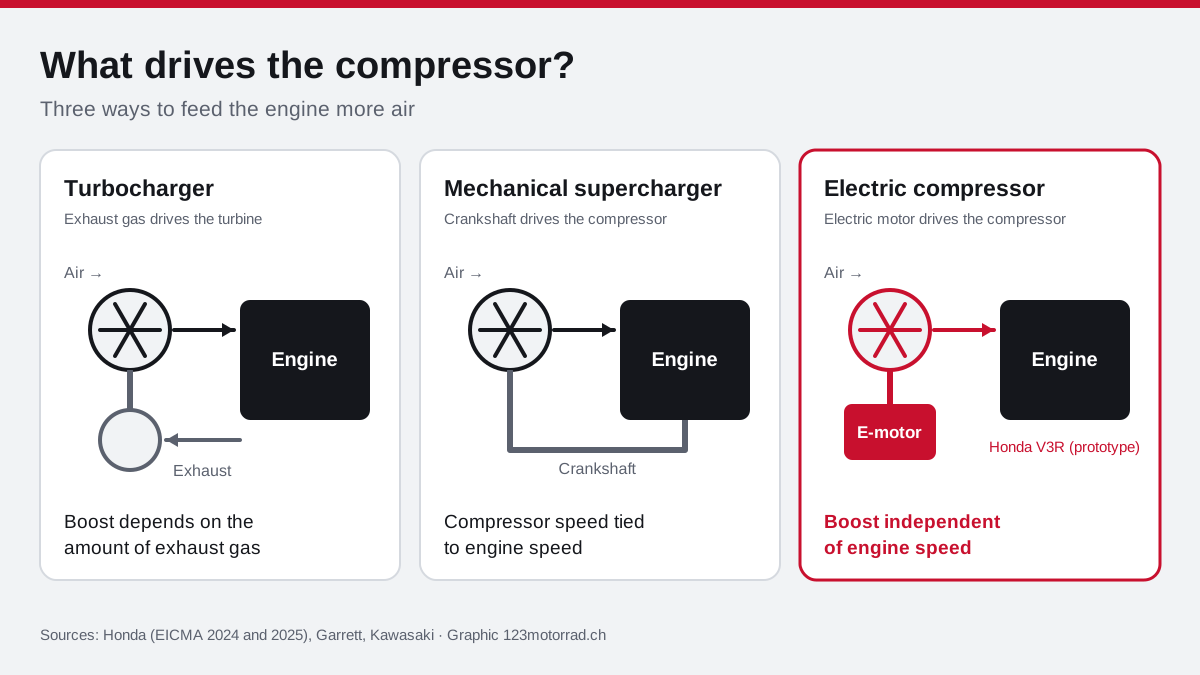
Turbocharger: the exhaust gas drives the compressor
In a turbocharger, the exhaust gas flows through a turbine wheel and turns it – according to the manufacturer Garrett, at up to 350,000 revolutions per minute. On the other side, a shaft drives the compressor wheel; the compressed air usually passes through an intercooler into the engine. Because the boost pressure depends on the volume of exhaust gas, little pressure is produced at low revs.
Mechanical supercharger: driven by the crankshaft
A mechanical supercharger is driven by the crankshaft. Its speed is therefore rigidly linked to engine speed. A well-known example on a motorcycle is the 2015 Kawasaki Ninja H2R: its impeller is driven via a planetary gear and turns 9.2 times faster than the crankshaft, i.e. almost 130,000 rpm at around 14,000 rpm engine speed. It has no intercooler.
Electric compressor: independent of engine speed and exhaust gas
In an electric compressor, an electric motor turns the compressor wheel – without exhaust gas and without a connection to the crankshaft. In cars, this has existed since 2016: the Audi SQ7 TDI compresses at up to 70,000 rpm, builds up boost pressure in under 250 milliseconds and draws up to 7 kW for this from a 48-volt electrical system.
On motorcycles, Honda is working on this solution: the Honda V3R900 is a prototype with a water-cooled V3, 900 cm³ and an electrically driven compressor. According to Honda, this allows the boost pressure to be controlled independently of engine speed, and no intercooler is needed.
Turbo vs supercharger – the comparison
| Turbocharger | Mechanical supercharger | Electric compressor | |
|---|---|---|---|
| Drive | Exhaust gas via a turbine | Crankshaft via a gear drive | Electric motor |
| Boost pressure depends on | Exhaust gas volume | Engine speed | Control system, independent of engine speed |
| Intercooler | usually yes | no on the Ninja H2R | not needed on the Honda prototype, according to Honda |
| Example | Honda CX500 Turbo (1982) | Kawasaki Ninja H2R (2015) | Audi SQ7 TDI (2016), Honda V3R900 (prototype) |
Forced induction on motorcycles: a brief look back
Honda has used forced induction before: the CX500 Turbo arrived in 1982, the CX650 Turbo in 1983. The goal was the power of a larger engine with lower fuel consumption. According to the specialist magazine Hagerty, the turbo motorcycles of the 1980s were expensive and offered few tangible advantages over naturally aspirated engines; the industry quickly returned to the naturally aspirated engine. Driving the compressor electrically targets what depends on the exhaust gas volume with a turbo: boost pressure even at low revs. What Honda has shown and patented on this so far is on the Honda V3R900 E-Compressor page.
Frequently asked questions about turbo vs supercharger on motorcycles
What is the difference between a supercharger and a turbocharger?
The turbocharger is driven by the exhaust gas via a turbine, the mechanical supercharger by the crankshaft. With the electric compressor, it is an electric motor.
Turbo vs supercharger – which is better?
That depends on the goal: the turbo uses the energy of the exhaust gas but delivers little pressure at low revs. The mechanical supercharger is linked to engine speed. The electric compressor can deliver boost pressure independently of engine speed and exhaust gas, but needs electricity to do so.
Are there motorcycles with a supercharger?
Yes, for example the Kawasaki Ninja H2 and H2R with a mechanical supercharger since 2015. With the Honda V3R900 prototype, Honda is working on an electric compressor.
Does a supercharger need an intercooler?
Not necessarily. With a turbocharger, the compressed air usually passes through an intercooler; the Ninja H2R manages without one, and according to Honda, no intercooler is needed on the Honda E-Compressor either.
What is an electric compressor?
A compressor driven by an electric motor. It needs neither exhaust gas nor the crankshaft and can therefore deliver boost pressure at any time.
More from Honda Motorrad Zürich and the MX-Academy
- honda-motorrad-zuerich.chHonda V3R900 E-Compressor
- honda-motorrad-zuerich.chHonda E-Clutch
- honda-motorrad-zuerich.chHonda motorcycle test ride
- honda-motorrad-zuerich.chHonda Motorrad Zürich